PACKINT - Chocolate Machines

China Top Chocolate Coins Supplier for Global Buyers?

Global demand for chocolate continues to expand, creating new opportunities for specialized products such as chocolate coins. Fortune Business Insights valued the global chocolate market at approximately USD 131.7 billion in 2023. Its report also projects steady growth through 2032, supported by premium gifting, seasonal celebrations, and emerging-market consumption.

China has become a practical sourcing base for international confectionery buyers. Experienced manufacturers can provide foil-wrapped chocolate coins in different diameters, cocoa percentages, colors, and private-label designs. A buyer may request gold foil coins for Christmas, silver coins for wedding favors, or custom wrappers showing a brand logo. Small details matter. Foil quality, chocolate bloom resistance, carton strength, and delivery temperature can affect the final customer experience.

However, a catalogue is not proof of capability. Buyers should verify food-safety systems, ingredient traceability, allergen controls, and production consistency. Certifications such as BRCGS, ISO 22000, or HACCP can support supplier evaluation, but they should not replace factory audits and sample testing. International Trade Centre data for HS 1806 can help buyers compare chocolate trade patterns, although chocolate coins are not always reported as a separate category. This is an important limitation.

The strongest China supplier is not necessarily the cheapest one. Reliable communication, accurate documentation, stable recipes, and realistic lead times often reduce total procurement risk. Buyers should request a certificate of analysis, packaging specifications, shelf-life evidence, and pre-shipment inspection records. In practice, one successful sample proves little. Repeated production proves much more.
China Top Chocolate Coins Supplier for Global Buyers?

What Are Chocolate Coins and Why Are They Popular Worldwide?

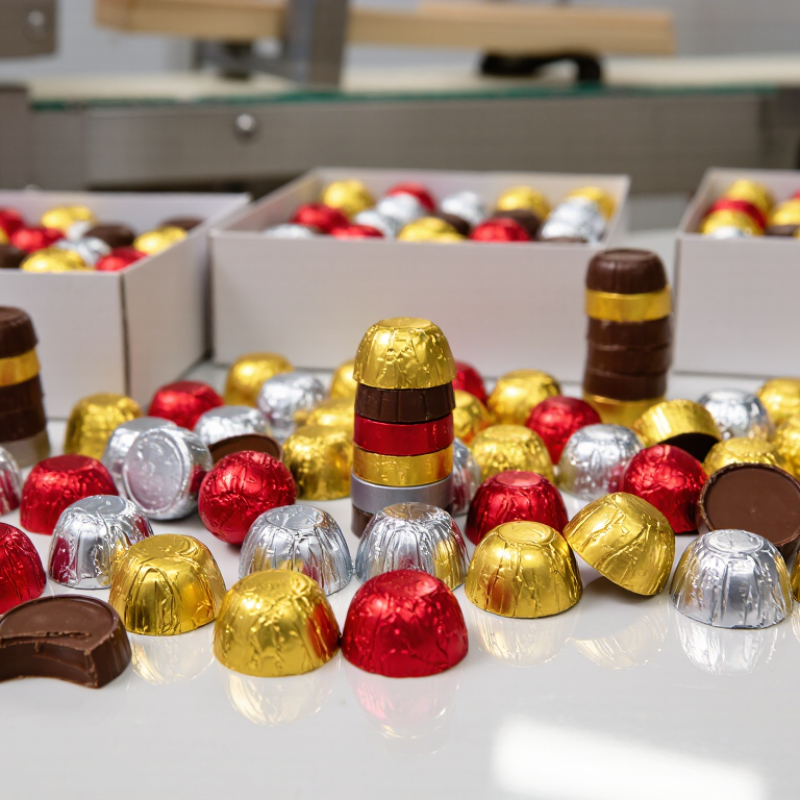
Chocolate coins are small, foil-wrapped pieces of molded chocolate, often designed to resemble coins. Their round shape makes them easy to display, share, and pack for seasonal events. Children enjoy the surprise, while adults often connect the coins with celebration, gifting, and childhood memories.

Their popularity comes from simple visual appeal and flexible use. A gold-colored wrapper can brighten a holiday table, candy buffet, or promotional gift box. Buyers can request different chocolate flavors, coin sizes, foil colors, and outer packaging. In real sourcing work, these details affect cost and delivery time. A sample may look attractive, yet the foil can loosen during shipping. The chocolate may also soften in warm weather.

Reliable suppliers usually provide ingredient information, production details, packaging specifications, and quality records before an order is confirmed. Global buyers should check cocoa flavor, surface finish, weight tolerance, allergen controls, and carton strength. A clean snap and smooth surface often show careful processing, but they do not replace laboratory checks. This is where some purchasing plans fall short. They focus on appearance and price, then overlook storage conditions and transport temperature. A practical supplier should communicate clearly, offer pre-production samples, and explain how the coins are protected from heat and moisture. Small details matter.

How to Evaluate China’s Leading Chocolate Coin Suppliers

China Top Chocolate Coins Supplier for Global Buyers?

How to Evaluate China’s Leading Chocolate Coin Suppliers

Choosing a reliable chocolate coin supplier requires more than comparing prices. A professional evaluation starts with product samples, factory records, and clear communication. During sample reviews, check the coin’s shine, snap, aroma, and foil quality. The chocolate should melt evenly, without a waxy aftertaste. Packaging details also matter. Inspect seals, printing accuracy, carton strength, and storage instructions.

Ask suppliers for ingredient lists, allergen controls, food safety certificates, and batch traceability documents. Verify whether these records match the actual production facility. A polished website is not proof. Request a live factory video or an independent audit when possible. Confirm production capacity using realistic figures, not impressive claims. Lead times should include ingredient purchasing, production, inspection, and shipping.

Tips: Order samples from several suppliers. Compare them under the same conditions. Ask for a recent production batch, not only a showroom sample. Check how quickly the supplier answers difficult questions. Slow or vague replies may create problems later. Also confirm minimum order quantities, payment terms, customization limits, and complaint procedures in writing. I have found that small packaging details can expose larger quality issues. This step is easy to underestimate.

What Manufacturing Standards Ensure Safe, High-Quality Chocolate Coins?

Chocolate coin production for global buyers demands more than attractive molds and competitive pricing. Safe output begins with documented GMP and HACCP controls throughout the facility. Workers should follow hygiene procedures, wear protective clothing, and separate raw materials from finished products.

Traceability matters. Each batch needs coded records for cocoa ingredients, milk powder, allergens, processing dates, and packaging materials. Reliable factories test for pathogens, foreign objects, moisture, and allergen cross-contact. Metal detection should be verified at scheduled intervals, not simply switched on. Food-grade packaging must protect the coins from heat, humidity, dust, and strong odors during shipping.

Tempering also affects quality. Correct cooling creates a clean snap, smooth surface, and stable shine. Poor temperature control can cause fat bloom, leaving pale streaks across the chocolate. A factory should retain samples, issue batch documentation, and provide testing records from qualified laboratories when required. Independent audits add useful evidence, but they do not replace daily supervision.

Small defects matter. A loose wrapper, uneven coin edge, or missing lot code can weaken buyer confidence. During supplier reviews, it is wise to inspect production areas, sample finished cartons, and compare specifications with actual products. No process is perfect. Even a well-managed line may need corrective action after a failed seal or inconsistent weight. Destination requirements also differ, so packaging, labeling, and testing should be checked for each market before shipment.

China Top Chocolate Coins Supplier for Global Buyers? - What Manufacturing Standards Ensure Safe, High-Quality Chocolate Coins?

Manufacturing Area Recognized Standard or Regulation What It Covers Practical Requirement for Chocolate Coins Documents or Evidence Global Buyers Can Request
Food safety management ISO 22000:2018 A food safety management system based on hazard analysis, operational controls, communication, and continual improvement. The facility should identify and control biological, chemical, physical, and allergen hazards throughout receiving, processing, molding, cooling, wrapping, and storage. Valid certificate, certification scope, latest audit report or summary, corrective-action records, and certificate verification details.
Hazard analysis and preventive controls Codex Alimentarius CXC 1-1969, General Principles of Food Hygiene, revised 2022 Good hygiene practices and the HACCP approach for preventing food safety hazards. A documented HACCP plan should cover chocolate handling, inclusions, rework, metal detection, sanitation, temperature control, and finished-product release. HACCP plan, hazard-analysis flow chart, critical-control-point monitoring logs, verification records, and sanitation procedures.
Chocolate composition and identity Codex CXS 87-1981, General Standard for Chocolate and Chocolate Products Definitions, composition, permitted ingredients, labeling principles, and quality requirements for chocolate products. The declared product type, cocoa content, milk ingredients, vegetable fats, sweeteners, and other ingredients should comply with the destination market’s legal requirements. Formula specification, ingredient percentages, raw-material specifications, product data sheet, and destination-country compliance review.
Allergen management Codex allergen-labeling principles; EU Regulation (EU) No 1169/2011 where applicable Identification, control, and declaration of priority allergens and cross-contact risks. Milk, soy, nuts, peanuts, wheat, and other relevant allergens must be accurately declared when present or when cross-contact cannot be adequately prevented. Allergen matrix, cleaning-validation records, line-clearance records, label artwork, and supplier allergen declarations.
Microbiological safety Destination-market food microbiology rules and validated laboratory methods Verification that finished products are free from unacceptable microbial contamination. Testing should be risk-based and may include Salmonella and indicator organisms, especially for products containing milk powder, nuts, or other inclusions. Recent certificate of analysis, accredited laboratory report, sampling plan, test methods, and batch or lot traceability.
Chemical contaminants Applicable contaminant limits in the importing market, including EU Regulation (EU) 2023/915 where relevant Controls for contaminants such as lead, cadmium, mycotoxins, and process-related contaminants. Cocoa, sugar, dairy powders, nuts, and other ingredients should be sourced under approved specifications and tested according to risk and legal requirements. Supplier approval records, contaminant test reports, raw-material certificates of analysis, and compliance statements for the target market.
Foreign-material prevention HACCP-based preventive controls and recognized food-safety certification schemes Prevention and detection of metal, glass, plastic, stones, and other physical hazards. Metal detectors, magnets, sieves, visual inspections, and equipment-maintenance controls should be validated and routinely checked. Detection sensitivity records, challenge-test logs, calibration certificates, maintenance records, and corrective-action reports.
Packaging safety EU Regulation (EC) No 1935/2004 and GMP Regulation (EC) No 2023/2006 where applicable Food-contact materials must not transfer substances that endanger health or cause unacceptable changes to the food. Foil, paper, plastic film, inks, adhesives, and inner bags used for chocolate coins should be suitable for direct food contact and intended storage conditions. Food-contact declaration, material specification, migration-test report when required, packaging traceability, and ink or adhesive compliance documents.
Weights and quantity control Legal metrology requirements in the destination country Accuracy of declared net weight, count, and package quantity. The declared net weight or number of coins should be supported by calibrated scales, statistical checks, and documented corrective actions for underweight packs. Scale calibration records, in-process weight-control logs, finished-pack inspection results, and approved packaging specifications.
Traceability and recall Codex traceability principles and applicable importing-country laws Ability to trace ingredients, packaging, processing records, and distribution by lot. Each production lot should link to raw-material batches, processing dates, packaging records, inspection results, and shipment information. Lot-coding procedure, one-step-back/one-step-forward records, mock-recall results, and retention-time policy.
Storage and transport stability Good storage and distribution practices; product-specific validated conditions Protection against heat, moisture, odors, pests, physical damage, and excessive temperature fluctuation. Chocolate coins should be stored in clean, dry conditions away from strong odors and direct sunlight; recommended temperature and humidity limits should be validated for the formulation and packaging. Shelf-life study, packaging performance data, warehouse records, transport instructions, and temperature or humidity monitoring records.
Labeling and consumer information Destination-market labeling law; examples include Regulation (EU) No 1169/2011 and U.S. FDA food-labeling requirements Product name, ingredient list, allergen declaration, net quantity, lot identification, dates, storage instructions, and responsible food-business information. Artwork should match the approved formula and the legal requirements of every intended sales market; nutrition and claims must be substantiated. Final label artwork, ingredient and allergen review, nutrition calculation, claim substantiation, and regulatory approval checklist.
Supplier qualification and audit readiness Recognized third-party food-safety certification schemes and buyer audit programs Verification that the manufacturing site, ingredient suppliers, laboratories, and packaging suppliers operate under controlled systems. A capable supplier should maintain approved-vendor lists, internal audits, employee training, complaint handling, nonconformance control, and documented improvement actions. Current certificate, audit scope, internal-audit summary, training records, complaint statistics, corrective-action closure, and production-capacity information.

Note: Applicable limits and labeling requirements vary by destination market. Buyers should confirm the current legal requirements for the countries where the chocolate coins will be imported and sold.

Which Customization and Packaging Options Suit Global Buyers?

For global buyers, chocolate coins need more than an attractive shape. Customization should match the market, occasion, and shipping conditions. Buyers can request different coin diameters, foil colors, embossed patterns, and printed messages. Food-safe inks and approved foil materials are essential. A small design detail can affect production speed and cost.

Packaging choices should protect both appearance and quality. Individual foil wrapping suits gift boxes, event favors, and retail displays. Clear bags offer visibility, while rigid cartons provide stronger protection during transport. For large orders, inner trays can reduce movement and prevent scratches. Moisture-resistant outer cartons are useful in humid climates. Temperature-controlled shipping may also be necessary during warmer seasons.

Reliable suppliers should provide artwork proofs, material specifications, sample approval, and batch inspection records. Labels may need ingredients, allergens, net weight, origin, shelf life, and storage conditions. Requirements differ between countries, so buyers should confirm them before printing.

Minimum order quantities can limit small custom projects. That is worth discussing early.

Not every package performs equally well. A glossy finish may look premium but show fingerprints. Thin foil can reduce cost but tear during handling. Experienced buyers often test packaging through transport simulation before placing repeat orders.

That extra step feels slow. It prevents expensive surprises.

How to Compare Pricing, Shipping, and Supplier Reliability?

China Top Chocolate Coins Supplier for Global Buyers?

Comparing chocolate coin suppliers requires more than checking the lowest quotation. Cocoa prices change quickly. The International Cocoa Organization reported severe supply pressure during the 2023/24 season, with global production estimated below grindings. This gap can affect chocolate prices, fillings, and delivery commitments. Ask suppliers to separate cocoa, packaging, labor, and freight costs. A transparent quotation is easier to review.

Shipping deserves equal attention. UNCTAD’s Review of Maritime Transport 2024 states that ships carry over 80% of global merchandise trade. Yet freight rates can rise sharply during route disruptions. Request FOB and CIF prices, carton dimensions, gross weight, pallet details, and the nearest loading port. Compare the complete landed cost, not only the factory price. I have found that small packaging changes sometimes reduce freight more than negotiation does. Still, this is not always true.

Tips: Ask for recent invoices, production photos, batch records, and a small sample order. Check food-safety controls, allergen procedures, and traceability documents. ISO 9001 and HACCP evidence can support supplier evaluation, but certificates alone prove little. Review audit dates and issuing bodies. Track response time, sample consistency, defect handling, and on-time shipment history. A written contract should define tolerances, inspection rights, payment stages, and remedies. Forecasts remain imperfect. Build a backup supplier before pressure arrives.

How to Compare China Chocolate Coin Suppliers

A practical 100-point evaluation framework for global buyers comparing pricing, shipping, and supplier reliability.

The scorecard gives the highest weight to total sourcing cost, including product pricing, packaging, freight coordination, and payment terms. Shipping performance considers lead-time clarity, export documentation, and delivery consistency. Reliability includes quality control, food-safety documentation, production capacity, and communication. Buyers should adjust the weighting according to destination-market requirements.