
Why Choose a Multi Lane Powder Packing Machine?
Why Choose a Multi-Lane Powder Packing Machine?
Powder packaging looks simple until production begins. Fine particles drift, bridge, cling, or settle unevenly. A Multi-Lane Powder Packing Machine addresses these problems through synchronized filling, sealing, and film control. It creates several sachets during one production cycle. That difference can reshape factory output.
Packaging expert Walter Soroka defines packaging as “the science, art, and technology of enclosing and protecting products.” His statement explains why equipment selection requires more than speed. Operators must examine powder flow, bulk density, moisture sensitivity, target weight, and package format. A machine handling flour may not suit instant coffee or powdered supplements. Small differences matter.
Multiple lanes can increase output without requiring a larger footprint. Servo-driven augers support controlled dosing. Automatic film tracking helps maintain clean seals. Integrated sensors can detect missing film, poor registration, or abnormal filling. These features reduce repetitive manual adjustments and improve batch consistency. They also make quality checks easier.
However, higher speed is not automatically better. Poorly matched tooling can create dust, seal contamination, and costly product loss. Cleaning may also take longer than expected. That part is often overlooked. A practical evaluation should include changeover time, spare-part access, operator training, and sanitation procedures. These details decide whether the investment performs well beyond its brochure promises.
For regulated food, pharmaceutical, and nutritional applications, documentation is equally important. Verify materials, machine records, safety systems, and applicable local requirements. A reliable supplier should demonstrate performance with your actual powder. Ask for test runs. Watch the seals. Measure the weights. Then question the results honestly. The best Multi-Lane Powder Packing Machine is not merely fast; it is stable, serviceable, and suitable for the product.
What Is a Multi Lane Powder Packing Machine?
Why Choose a Multi Lane Powder Packing Machine?
What Is a Multi Lane Powder Packing Machine?
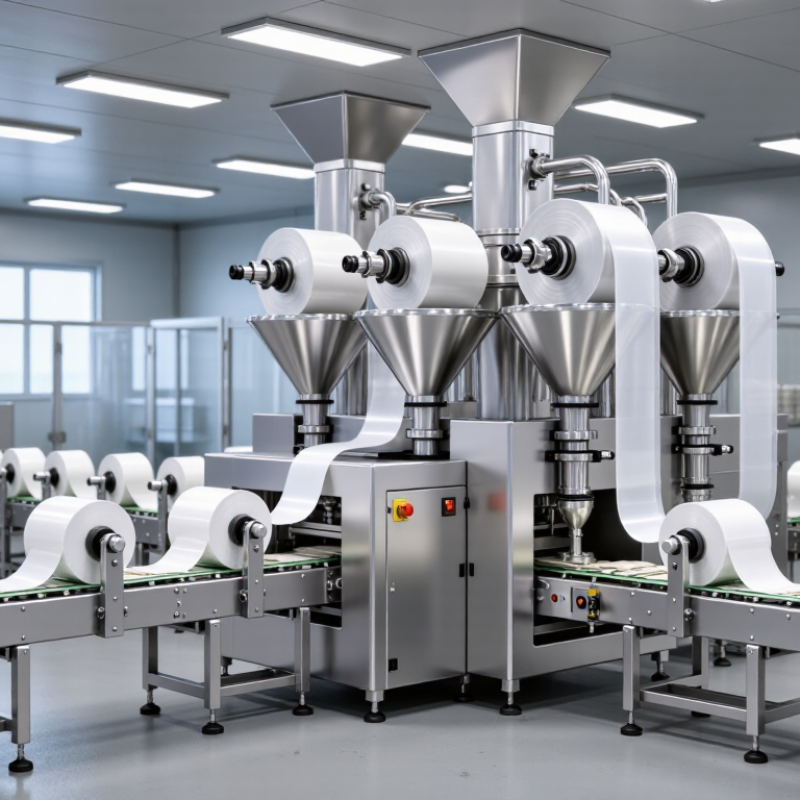
A multi lane powder packing machine forms and fills several small pouches at the same time. Each lane usually includes a film former, powder dosing unit, heat sealer, and cutting system. An auger filler measures powder by controlled screw rotation. This setup suits products such as flour, seasoning, milk powder, and other permitted dry materials.
In daily production, operators adjust the auger speed, filling volume, sealing temperature, and film tension. Accurate settings help reduce product waste and uneven pouch weights. The machine can also use sensors to detect film marks and maintain cutting positions. However, powder behavior is not always predictable. Fine powder may bridge inside the hopper, while humid powder can affect feeding accuracy. Real testing remains essential.
Tips: Check powder flow before selecting the machine. Ask for sample trials using your actual material. Measure pouch weight across every lane, not only the first one. Clean contact surfaces regularly, especially after dusty production. A faster machine is not always better if sealing quality suffers. Operators should record adjustments, because small changes can influence several lanes at once.
Why Choose a Multi Lane Powder Packing Machine? - What Is a Multi Lane Powder Packing Machine?
| Comparison Dimension | Single Lane | 2 Lanes | 4 Lanes | 6 Lanes | 8 Lanes |
|---|---|---|---|---|---|
| Basic Operating Principle | One dosing and sealing lane produces one pouch at a time. | Two synchronized dosing and sealing lanes operate in parallel. | Four synchronized lanes increase output within one machine frame. | Six lanes are used for higher-volume simultaneous production. | Eight lanes provide high-throughput multi-lane production when product demand supports the investment. |
| Typical Output Range | Approximately 20–60 pouches per minute | Approximately 40–120 pouches per minute | Approximately 80–240 pouches per minute | Approximately 120–360 pouches per minute | Approximately 160–480 pouches per minute |
| Common Pouch Format | Small stick packs or narrow sachets | Stick packs and compact three-side-seal sachets | Stick packs or sachets for retail and portion packaging | High-volume stick packs or multi-lane sachets | High-volume portion packs and narrow-format sachets |
| Typical Fill Range | About 0.5–100 g, depending on the auger and product | About 0.5–100 g, depending on the auger and product | About 0.5–100 g, depending on the auger and product | About 0.5–100 g, depending on the auger and product | About 0.5–100 g, depending on the auger and product |
| Filling Technology | Usually an auger filler for powders with stable flow characteristics | Multi-head auger dosing with synchronized feed control | Independent or centrally driven auger dosing across four lanes | Six synchronized auger dosing units with individual adjustment capability | Eight synchronized auger dosing units for continuous high-volume operation |
| Typical Dosing Accuracy | Often within approximately ±1–2%, subject to powder properties and calibration | Often within approximately ±1–2%, subject to powder properties and calibration | Often within approximately ±1–2%, subject to powder properties and calibration | Often within approximately ±1–2%, subject to powder properties and calibration | Often within approximately ±1–2%, subject to powder properties and calibration |
| Recommended Production Scale | Product trials, low-volume production, and frequent changeovers | Small to medium production runs | Medium to high production demand | High-volume production with regular order schedules | Large-scale production requiring maximum lane utilization |
| Space Efficiency | Lowest output density but generally simple to install | Higher output per machine footprint than a single-lane unit | Good balance between floor space and production capacity | High output from a relatively compact continuous packaging system | Very high output density, but it requires more installation and service clearance |
| Operational Advantages | Simple operation, easy cleaning, and lower initial investment | Improved productivity while retaining manageable setup procedures | Higher throughput with better utilization of operators and utilities | Reduced cost per pouch when demand is consistently high | Maximum production capacity and efficient labor utilization for suitable products |
| Key Considerations | May not meet high-volume demand without adding additional machines | Requires lane synchronization and consistent powder feeding | Changeover and cleaning procedures require more planning | Product flow consistency and preventive maintenance become increasingly important | Higher capital cost, more complex maintenance, and greater sensitivity to uneven powder distribution |
| Suitable Powder Products | Seasoning, instant drink powder, flour, spices, and nutritional powders | Seasoning, coffee powder, salt, sugar, and powdered supplements | Food powders, detergent powders, pharmaceutical powders, and agricultural powders | High-demand food, chemical, and household powder products | Large-volume retail, food-service, and industrial powder applications |
| When to Choose This Configuration | Choose when flexibility, low investment, and simple operation are more important than maximum output. | Choose when production demand is growing and a moderate capacity increase is required. | Choose when a strong balance between throughput, floor space, and operating cost is needed. | Choose when stable high-volume orders justify greater automation and capacity. | Choose when consistent demand, available floor space, and technical support can justify the highest throughput level. |
Note: Output, filling range, and dosing accuracy are typical engineering reference values. Actual performance depends on powder flowability, bulk density, moisture, particle size, pouch dimensions, film characteristics, auger design, and machine settings.