
PACKINT - Chocolate Machines

Why Choose a Jacquard Driving Board for Textile Machines?

Choosing the right control component can determine how smoothly a textile machine performs over long production cycles. A Jacquard Driving Board translates pattern instructions into precise actuator movements, helping control hooks, needles, or electronic selection systems. Its performance affects pattern accuracy, fabric consistency, response speed, and machine downtime.

Small details matter. A stable board should communicate reliably with the machine’s controller, maintain accurate timing, and tolerate vibration, heat, and continuous operation. In practical settings, technicians often inspect connectors, signal quality, cooling conditions, and firmware compatibility before installation. These checks can prevent skipped patterns, irregular designs, and unexpected stops during weaving.

Reliability is not only about buying the newest model. It depends on matching the board with the machine architecture, drive system, voltage range, and production requirements. A technically advanced board may still perform poorly when wiring, software, or mechanical timing is unsuitable. That point is easy to overlook.

Real-world experience also shows that maintenance records provide valuable evidence. Repeated alarms, unstable communication, or heat marks may reveal deeper compatibility problems. Operators should compare supplier specifications with actual machine conditions and request clear testing information. Independent technical advice can strengthen that decision.

No component is perfect. Even a well-designed Jacquard Driving Board may require calibration, replacement parts, or periodic inspection. However, the right choice can improve control accuracy and reduce avoidable interruptions. Understanding these benefits helps textile manufacturers evaluate whether this technology fits their equipment, fabric designs, and long-term production goals.
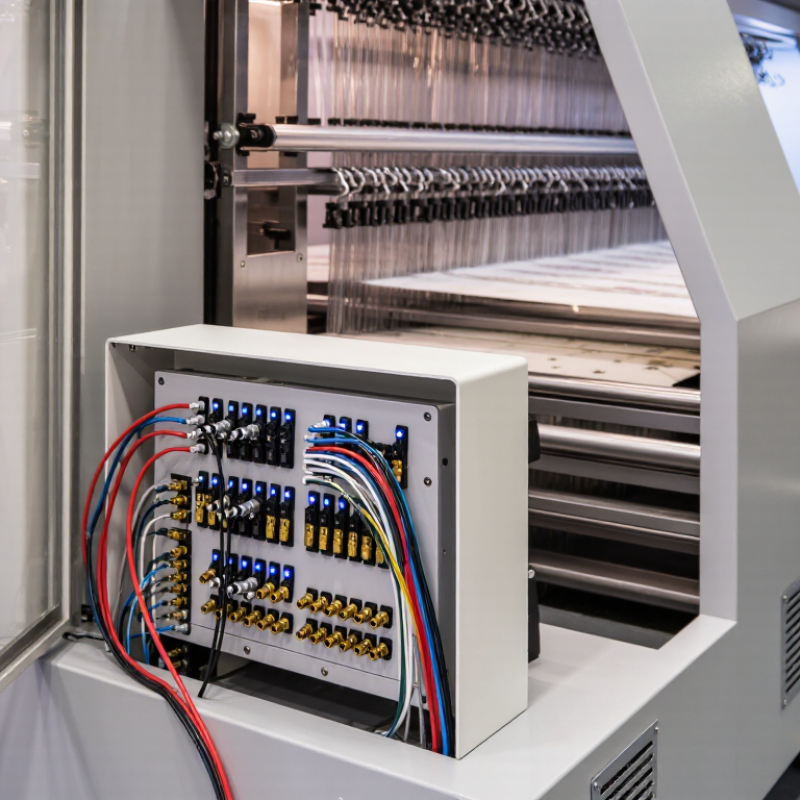
Why Choose a Jacquard Driving Board for Textile Machines?

Jacquard Driving Boards: Definition, Structure, and Control Functions

Why Choose a Jacquard Driving Board for Textile Machines?

A Jacquard driving board is the control interface between pattern software and textile machine actuators. It converts digital design data into timed electrical signals. Each signal raises, lowers, or selects individual warp threads during weaving. This precise control creates detailed motifs, textured surfaces, and repeated patterns.

The board usually contains a processing unit, power regulators, driver circuits, communication ports, and protection components. Some systems also include feedback sensors for position and fault monitoring.

During operation, the processor reads pattern instructions and synchronizes them with the main shaft. The driver circuits then manage solenoids or other actuators with carefully controlled voltage and timing. Fast switching matters here. Delays can produce broken motifs or uneven fabric edges.

In practical maintenance, technicians inspect connectors, heat marks, and signal stability before replacing major parts. A clean enclosure helps prevent dust from affecting cooling and contact quality. However, no driving board solves every production problem. Incorrect pattern files, worn actuators, or poor calibration can create similar symptoms. This is where careful testing matters. Measure signals under operating conditions, not only on a workbench. I have found that small timing differences may remain unnoticed until the fabric is examined under strong light. Regular parameter checks, stable power input, and documented maintenance improve reliability, although occasional adjustment is still necessary.

Hook Capacity from 192 to 25,600: Matching Boards to Weaving Needs

Why Choose a Jacquard Driving Board for Textile Machines?

Hook capacity directly shapes a loom’s design options. A 192-hook board may suit narrow ribbons, labels, and simple geometric patterns. It can reduce wiring, installation time, and maintenance effort. For wider fabrics, a 1,200 or 2,400-hook board offers more pattern control. The correct choice depends on fabric width, repeat size, and required detail.

At the upper range, 25,600 hooks support complex designs across broad textile surfaces. Fine floral lines, layered motifs, and demanding color changes need accurate individual control. During machine evaluations, technicians should check hook response, operating speed, heat generation, and signal stability. Capacity matters, but it does not work alone. A powerful board cannot correct poor harness alignment or unsuitable lifting settings.

A practical selection starts with the finished fabric, not the largest available number. Buyers should confirm compatibility with the loom controller, solenoid arrangement, power supply, and software interface. Spare parts and service access also affect long-term reliability. Bigger is not always better. I have seen oversized systems add cost without improving the final pattern. That is an easy mistake to repeat. A well-matched board delivers steadier weaving, cleaner motifs, and more predictable production.

Operating at 300–700 RPM: How Boards Improve Timing Accuracy

Why Choose a Jacquard Driving Board for Textile Machines?

At 300–700 RPM, timing errors can quickly become visible in woven patterns. A reliable jacquard driving board coordinates electronic signals with needle movement, helping each hook lift at the intended moment. This control reduces missed selections, uneven motifs, and repeated fabric defects. Timing matters.

The board must respond consistently under changing loads and operating speeds. Good systems use stable signal processing, accurate feedback, and adjustable timing parameters. During routine machine checks, technicians should compare actual movement with the programmed sequence. A small delay may seem harmless, but it can shift a dense pattern by several rows. The board is not magic. Mechanical wear, loose connections, and poor calibration still affect performance. I have also found that operators sometimes replace components before checking basic timing settings.

Tips: Record the speed, pattern, and fault location during testing. Inspect connectors for dust or vibration damage. Use a reference fabric after calibration. Check it twice. If defects appear only at higher RPM, reduce the speed temporarily and compare results. This simple test can separate an electronic timing issue from a mechanical one.

A suitable driving board also supports smoother production planning. Stable timing can reduce trial fabric, setup interruptions, and unnecessary adjustments. However, performance depends on the complete machine system, not one component alone. Regular cleaning, careful parameter changes, and documented maintenance create more dependable results. In practical production, small improvements in timing accuracy often protect both fabric quality and operator confidence.

Why Choose a Jacquard Driving Board for Textile Machines? — Operating at 300–700 RPM: How Boards Improve Timing Accuracy

Performance Dimension 300 RPM 500 RPM 700 RPM Practical Relevance of a Jacquard Driving Board
Machine speed 300 revolutions/minute 500 revolutions/minute 700 revolutions/minute Represents the operating range commonly encountered in medium- to high-speed textile machinery. The control board must maintain stable timing across changing speeds.
Time per shaft revolution 200.00 ms 120.00 ms 85.71 ms As rotational speed rises, the available time for selecting and positioning hooks, needles, or actuators becomes shorter.
Time per 1° of rotation 0.556 ms 0.333 ms 0.238 ms Shows why precise encoder feedback and deterministic signal processing are important for accurate pattern execution.
Time per 0.5° of rotation 0.278 ms 0.167 ms 0.119 ms A finer timing reference allows output events to be scheduled more consistently, particularly at higher RPM.
Recommended position-feedback basis Incremental or absolute encoder Incremental or absolute encoder High-resolution encoder with stable indexing Angular feedback synchronizes board outputs with the main shaft instead of relying only on elapsed time.
Timing reference 1 revolution = 360° 1 revolution = 360° 1 revolution = 360° Using shaft angle as the reference helps preserve pattern position when machine speed changes during operation.
Output scheduling method Angle-based event scheduling Angle-based event scheduling Angle-based event scheduling with fast refresh Events can be linked to defined angular positions, reducing timing drift caused by speed variation.
Pattern repeatability factor Stable synchronization required Higher sensitivity to phase error Very high sensitivity to phase error At higher speed, even a small phase deviation can affect the position of a pick, shed, or design element.
Response to speed fluctuation Moderate correction demand High correction demand Very high correction demand Closed-loop feedback and deterministic processing allow the board to adjust output timing as shaft speed changes.
Electrical control benefit Coordinated actuator switching Reduced timing inconsistency Fast, repeatable actuator control A dedicated driving board can coordinate multiple channels with consistent logic levels and defined switching sequences.
Mechanical timing benefit Improved phase alignment Reduced phase drift Improved synchronization under demanding cycles Accurate electronic timing complements mechanical adjustments and helps maintain alignment between the pattern system and the main drive.
Typical engineering priority Reliability and basic synchronization Timing accuracy and thermal stability Latency, noise immunity, and thermal stability The required board specification should be matched to speed, actuator load, encoder resolution, switching frequency, and duty cycle.

Calculation basis: Revolution time = 60,000 ÷ RPM in milliseconds; time per degree = revolution time ÷ 360. Values are engineering calculations, while actual performance depends on encoder resolution, controller latency, actuator response, mechanical tolerances, and machine configuration.

IEC 60204-1 Safety and ISO 11111 Requirements for Textile Machinery

Why Choose a Jacquard Driving Board for Textile Machines?

A jacquard driving board controls many individual yarn actuators with precise timing. It can support complex patterns while reducing mechanical switching and timing errors. In production, stable signal control matters when needles move rapidly and repeatedly. Keep it practical. The board should match actuator voltage, load current, communication method, and machine speed. Poor matching can cause overheating, missed selections, or irregular fabric designs.

IEC 60204-1 places strong attention on electrical equipment safety in machinery. A suitable control design should support protective bonding, clear circuit identification, emergency stopping, isolation, and protection against unexpected restarting. Wiring terminals need secure labeling and accessible inspection points. Small details matter. During commissioning, technicians should verify continuity, insulation, stop functions, and control responses under realistic operating conditions. Documentation must describe residual risks, maintenance steps, and safe adjustment procedures.

ISO 11111 addresses safety requirements for textile machinery, including guarding, access, operating controls, and foreseeable machine hazards. A driving board cannot compensate for an unsafe enclosure or exposed moving parts. Its installation should work with interlocks and guarded access, not bypass them. Operators need visible status indicators and understandable fault messages. A design may pass bench testing yet behave differently under dust, vibration, or heat. That possibility deserves honest review. Regular inspection is necessary, because connectors loosen and settings drift over time.

Why Choose a Jacquard Driving Board for Textile Machines?

A suitable jacquard driving board should support safe electrical equipment, emergency-stop functions, protective measures, and clear verification procedures. The chart below compares the core safety topics addressed by IEC 60204-1 and the ISO 11111 textile-machinery safety series. A value of 1 means the topic is addressed by the standard’s scope; it is not a compliance score.

IEC 60204-1 focuses on the electrical equipment of machines, including control systems, emergency-stop circuits, protective bonding, overcurrent protection, documentation, and verification. ISO 11111 addresses safety requirements specific to textile machinery, including safeguarding and access to hazardous areas. Always confirm the applicable edition and perform a machine-specific risk assessment.

References: IEC 60204-1:2016, Safety of machinery — Electrical equipment of machines — Part 1; ISO 11111 series, Textile machinery — Safety requirements.

Electronic Control, Energy Efficiency, and Maintenance Cost Comparison

Why Choose a Jacquard Driving Board for Textile Machines?

Electronic control changes how a textile machine handles pattern selection. A Jacquard driving board sends precise signals to the lifting mechanism, reducing unnecessary movement during each cycle. In a busy weaving room, this can create smoother operation and more consistent fabric density. It also helps operators adjust patterns through digital settings rather than repeated mechanical changes.

Energy savings depend on the entire machine. A modern board may reduce idle motion and shorten adjustment time, but it cannot correct worn bearings or poor motor settings. Measuring kilowatt-hours per production hour gives a more reliable comparison than relying on claims.

Small differences matter. For example, fewer stopped cycles can lower energy waste during a long shift. Results still vary with fabric weight, speed, and operator habits.

Maintenance costs require a balanced view. Mechanical systems are familiar and often easy to repair locally. However, they may need frequent inspections, lubrication, and replacement of worn parts. Electronic boards usually reduce moving components, while dust, heat, loose connectors, and voltage changes can create new risks. I have seen a simple connector fault stop production for hours. That experience makes preventive checks essential. Keep a maintenance log, clean control cabinets carefully, and train technicians to read diagnostic signals. Spare electronic modules also cost more than some mechanical parts, so the calculation is not always tidy.