
PACKINT - Chocolate Machines

What Are the Top Types of PCB Micro Switches?

A Pcb Micro Switch may be tiny, but its choice can affect how a device feels and performs. A mouse button needs a crisp click. A control panel may need a switch that stays in position. These differences explain why “micro switch” can describe several compact switch styles, not just one design. The exact meaning also varies between suppliers. That label can be confusing.

This guide looks at common PCB-mounted options, including tactile, slide, DIP, pushbutton, and miniature snap-action switches. Each type serves a different purpose. Tactile switches suit brief, momentary inputs, while slide switches can select between circuit states. DIP switches provide small manual settings, often for configuration. Pushbutton and snap-action models offer other actuation styles and feedback. Small parts matter.

A useful comparison goes beyond appearance. Check the footprint, pin layout, operating force, travel, electrical rating, and expected cycle life against the product requirements. Also consider how the switch will be soldered and whether a user can reach it after assembly. A familiar click is not proof of long-term reliability. Datasheets and sample testing help, though real results can still differ between applications. This is worth checking carefully. The sections ahead explain the main types, their typical strengths, and the details that can guide a practical choice. Some product descriptions use overlapping terms, so confirm dimensions and specifications before ordering.
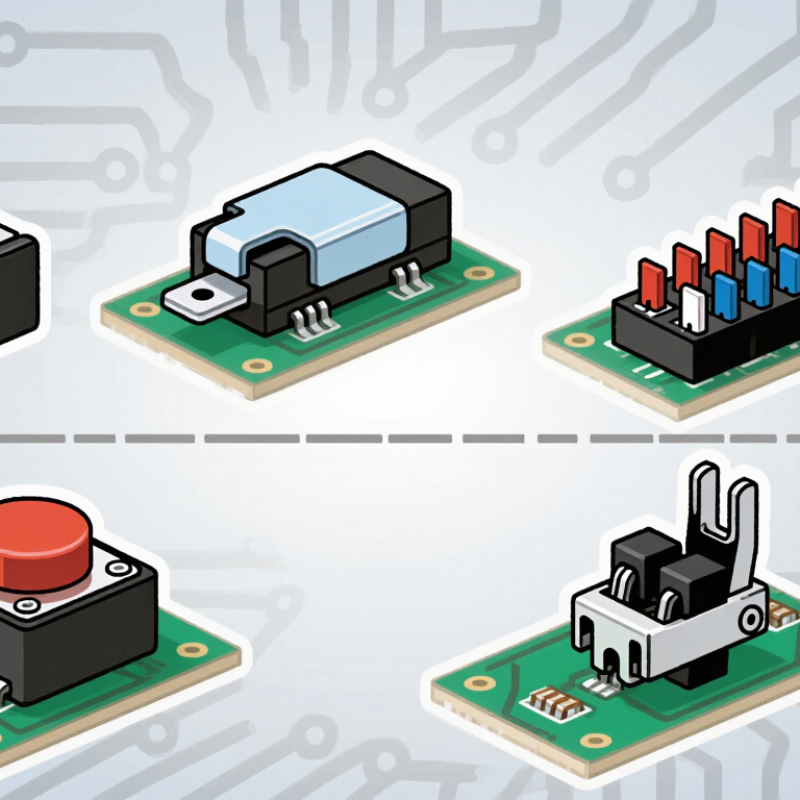
What Are the Top Types of PCB Micro Switches?

What Defines a PCB Micro Switch and How Does It Work?

A PCB micro switch is a compact, mechanically operated switch mounted directly on a printed circuit board. Its small size does not define how it works; a spring mechanism does. Pressing the actuator moves an internal contact, opening or closing an electrical circuit. In snap-action designs, a spring quickly changes the contact position after the actuator reaches a set point. The movement can feel crisp, even when the required force is light. That is the basic action.

Common PCB-mounted types include subminiature snap-action switches, tactile switches, and sealed versions designed to resist dust or moisture. They are not interchangeable. A tactile switch usually gives feedback when pressed, while a snap-action micro switch is selected for its switching behavior and operating force. Check the circuit rating, actuator travel, mounting pattern, and expected number of operations before choosing one. A mismatch can cause unreliable switching or premature wear.

Small details matter. A fraction of a millimeter in actuator travel may change whether a plastic button reliably reaches the switch. Board flex can also affect the feel, though it is easy to overlook during a quick bench test. Evaluate the switch in its actual enclosure, not only on an exposed board.

What Are the Top Types of PCB Micro Switches?

A PCB micro switch is a compact switch designed to mount directly onto a printed circuit board. Pressing or moving its actuator changes the electrical contact state; the mechanism may be tactile, snap-action, sliding, DIP, or rotary.

The chart shows example contact configurations, not a performance ranking: SPST provides one switched path, SPDT offers two selectable throws, and a 1P12T rotary configuration offers twelve positions. Actual configurations vary by component.

Which Design Features Distinguish PCB Micro Switches?

PCB micro switches differ through their mounting style, actuator shape, switching feel, and electrical design. Through-hole terminals pass through drilled board holes and can provide firm mechanical support. Surface-mount versions sit directly on copper pads, saving space but requiring careful soldering. Small parts matter.

The actuator determines how the switch meets a button, lever, or moving component. A short plunger suits compact, direct presses, while a roller lever can follow a moving surface with less friction. Designers also compare operating force, travel, and release point. A crisp click may help confirm activation, but sound alone does not prove reliable electrical contact.

Contact ratings and terminal layouts must match the circuit and available board space. Check the specified voltage and current, then allow room for solder joints and nearby components. Dust or moisture can affect exposed mechanisms, so sealed designs may help in harsher settings. Not always. Sealing can add size or change the feel. Tolerances matter, too: small shifts in switch height can change how consistently an enclosure presses the actuator. A prototype often reveals fit issues that drawings miss.

What Are the Main Types of PCB Micro Switches?

What Are the Main Types of PCB Micro Switches?

PCB micro switches are commonly grouped by how they mount and how their actuators move. Through-hole types use metal legs soldered into drilled board holes. They can suit sturdy, hand-assembled prototypes, though they take more board space. Surface-mount types sit directly on copper pads and support compact layouts. Their small bodies need careful placement and soldering. Tiny, but decisive.

Actuator shape is another useful distinction. A pin-plunger switch responds to a short, direct push, such as a panel button pressing straight down. Lever and hinge-lever types extend the contact point, helping when an enclosure leaves little room above the board. Roller-lever versions add a small wheel, which can reduce friction when a moving part slides across the actuator. Side-actuated switches respond to horizontal movement and can fit along a board edge.

Some models are sealed against dust or moisture, while open versions may be smaller and easier to inspect. Sealing does not mean the switch can tolerate every environment. Check the datasheet for operating force, travel, electrical rating, and mounting dimensions. These categories can overlap: a switch may be surface-mounted, sealed, and lever-actuated at once. Choosing by size alone is tempting, but access for assembly and replacement can change the decision.

How Do Actuation, Contact, and Mounting Styles Compare?

PCB micro switches differ most in how they move, make contact, and attach to a board. A straight plunger suits direct, compact pushes, such as a small button beneath an enclosure opening. Lever versions need less force and offer more travel. Roller levers can follow a moving surface with less sliding friction. The trade-off is space: a lever may extend beyond a tight board outline. Feel matters. A short click can be hard to detect through a thick cover.

Contact options shape the circuit, not just the switch feel. SPST models provide a simple on-off path, while SPDT models switch between normally open and normally closed contacts. Check the datasheet for the operating force, travel, and electrical rating; similar-looking parts can behave quite differently. Mounting style matters too. Through-hole terminals resist movement during handling and are easier to inspect, but use more board area. Surface-mount parts save space and suit automated assembly, yet small solder joints need careful layout and process control. I would not choose by footprint alone. A switch that fits perfectly can still be awkward to press or unreliable in its actual enclosure.

What Factors Guide PCB Micro Switch Selection?

Choosing a PCB micro switch starts with its job on the board. A tactile switch suits direct finger input, while a side-actuated or snap-action design may fit a constrained enclosure. Check the actuator direction against the available space. A few millimeters can decide whether the switch clears a nearby wall.

Then compare operating force, travel, and electrical rating with the user’s needs and circuit conditions. A light force may help frequent input, but can cause accidental presses in a vibrating device. Short travel saves space; it may also feel less distinct. Check the datasheet for contact rating, expected operating life, and recommended soldering conditions. Fit matters.

Mounting style deserves a close look. Through-hole terminals can offer sturdy anchoring, while surface-mount parts support compact layouts and automated assembly. Verify the footprint, actuator height, and clearance in the actual enclosure, not just on a screen. Dust, moisture, and temperature can affect reliability, so match the switch’s environmental rating to its location. A datasheet rarely captures the feel of a real button. Build a small test board and try it with the intended housing; sometimes the first choice feels wrong. That is useful evidence, not a failure.

What Are the Top Types of PCB Micro Switches? - What Factors Guide PCB Micro Switch Selection?

Category Switch Type or Selection Factor Typical Characteristics When It Is a Suitable Choice
Common Small Switch Types for PCB Applications
Momentary input Tactile switch Typically returns to its original state when released. Many versions provide a perceptible tactile click; available in through-hole and surface-mount formats. Push-button inputs on control panels, handheld devices, and compact electronic products. Check actuator height, mounting style, and required operating force.
Snap-action switching Subminiature snap-action switch A spring mechanism changes contacts rapidly after the actuator reaches its operating point. Versions may include a lever, plunger, or roller actuator. Position, door, and limit detection where defined actuation and contact switching are required. Confirm the PCB mounting method and mechanical load path.
Manual mode selection Slide switch A sliding actuator selects between two or more circuit positions. Both maintained and, less commonly, momentary configurations are available. Power, mode, or signal selection when the user needs a visible physical position. Verify pole count, throw count, and actuator access.
Manual mode selection Miniature rocker switch A pivoting actuator commonly provides a maintained on/off or changeover position. PCB-mounted versions are less common than panel-mounted designs. Applications requiring a larger, easy-to-operate control. Check board support, panel access, and whether the switch is intended for PCB or panel mounting.
Configuration setting DIP switch A row of small maintained switches, often using slide or piano-style actuators, for setting configuration or address options. Low-frequency setup choices that may be changed during installation or servicing. Consider switch pitch, number of positions, and accessibility.
Rotary selection Rotary or encoded switch Uses a rotating actuator to select among discrete positions; some designs provide direct contact outputs, while others provide encoded outputs. Multi-position settings such as channel or operating-mode selection. Check the output coding, position count, and PCB footprint.
Key Factors for Selecting a PCB Micro Switch
Electrical requirements Voltage, current, and load type Contact ratings depend on the switch design and the load. Inductive or capacitive loads can impose different stresses from resistive loads. Choose a part whose specified ratings cover the actual circuit conditions, including inrush current where relevant. Do not assume a low-level signal rating also permits power switching.
Contact configuration Poles and throws Single-pole, double-pole, and single- or multi-throw configurations determine how many circuits can be controlled and how contacts are routed. Match the contact arrangement to the schematic and verify the terminal layout against the PCB footprint.
Mechanical integration Footprint, mounting, and actuator dimensions Board space, lead spacing, body height, actuator travel, and clearance vary by switch and mounting style. Check the manufacturer’s dimensional drawing and recommended land pattern against the board, enclosure, and user-access requirements.
Operation Actuation force, travel, and feedback Operating force and travel affect how a switch feels and whether an actuator can be reached reliably. Tactile feedback is not present in every switch type. Select values appropriate for the user, actuator design, and risk of accidental operation; evaluate the complete mechanical assembly.
Switching behavior Momentary or maintained action Momentary switches return when released; maintained switches remain in the selected position until operated again. Use the behavior required by the circuit and interface. Confirm normally open, normally closed, or changeover contact behavior where applicable.
Reliability Electrical life and operating life Rated life varies with switch type, load, actuation conditions, and environment. Published endurance figures apply under stated test conditions. Compare life specifications under conditions representative of the intended application, rather than relying on a single cycle figure alone.
Environment Temperature, moisture, dust, and vibration Environmental limits and sealing levels differ. PCB mounting alone does not make a switch resistant to water, dust, or vibration. Check operating-temperature limits, protection details, and application conditions. Add enclosure-level protection when needed.
Assembly and service Through-hole or surface-mount construction Through-hole leads provide mechanical anchoring through the board; surface-mount parts support automated assembly and compact layouts. Match the switch to the assembly process and expected user force. Provide sufficient board support when the switch will be pressed repeatedly.

Note: “Micro switch” is often used informally for several compact switch types. A snap-action switch is a specific mechanism; tactile, slide, DIP, rocker, and rotary switches have different operating principles. Always confirm the exact specifications and footprint in the relevant product datasheet.