
What Are the Top PSA Activated Carbon Types in 2026?
In 2026, choosing a PSA Activated Carbon type means matching the adsorbent to the gas, operating cycle, and contaminants—not simply comparing surface-area figures. Coconut-shell and coal-based granular carbons are common options for pretreatment, moisture control, and removal of trace impurities. Wood-based grades may offer different pore structures, while impregnated carbons can target particular contaminants. Yet these materials are not interchangeable. In nitrogen generation, carbon molecular sieve is often the central selective adsorbent; ordinary activated carbon may support the system but does not perform the same role.
Adsorption authority Douglas M. Ruthven’s work offers a useful principle, paraphrased here: “Separation performance depends on the match between adsorbent properties and process conditions.” That distinction matters. A carbon bed facing humid gas may behave differently from one handling a dry, clean stream. Look beyond the label. Review pore-size distribution, hardness, pressure drop, dust generation, and regeneration conditions. Ask for test data under representative cycle times, not only a headline capacity measured in ideal conditions.
The “top” types depend on the application. Some buyers need robust granules that resist abrasion; others need a tailored surface chemistry. Supplier claims deserve verification. A small pilot test can reveal pressure-drop changes, early breakthrough, or uneven packing before a full installation. There is a limitation here: public product data rarely supports a universal 2026 ranking. Treat any fixed list with caution, and confirm performance against your actual feed gas and operating conditions.
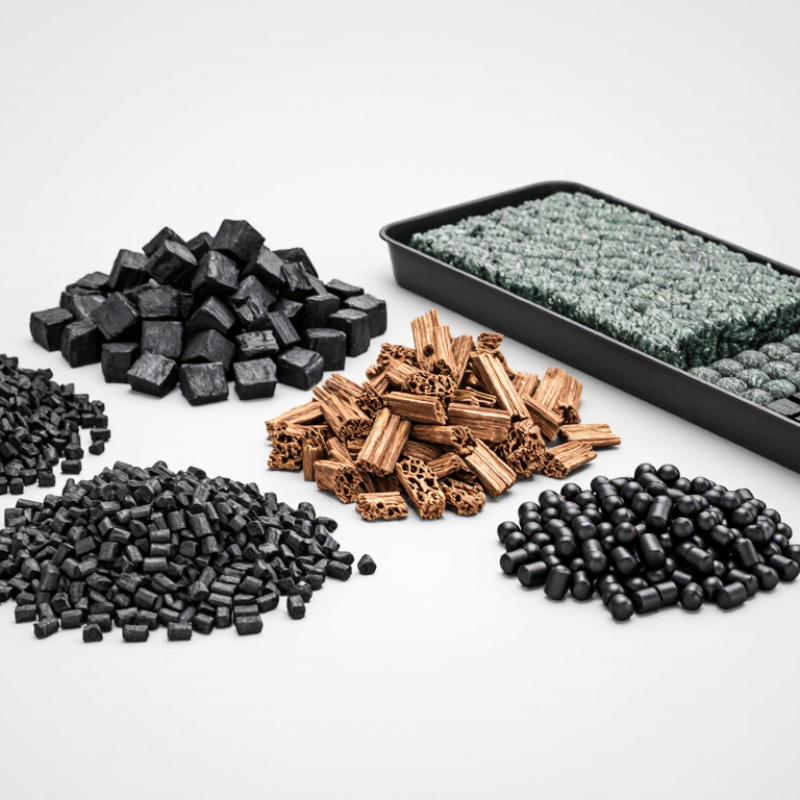
Define PSA Adsorbents: Activated Carbon vs. Carbon Molecular Sieve
PSA means pressure swing adsorption: gas passes through packed beds at higher pressure, while depressurization releases captured components. Activated carbon and carbon molecular sieve are both carbon adsorbents, but they do different jobs. Activated carbon has a broad pore network and is commonly used to capture carbon dioxide, heavier hydrocarbons, and other impurities. In hydrogen purification, it may serve as one layer in a multibed system, alongside adsorbents selected for other contaminants. Not interchangeable.
Carbon molecular sieve (CMS) has tightly controlled micropores that separate gases partly by how quickly molecules diffuse. In nitrogen PSA, oxygen generally enters these pores faster than nitrogen, allowing nitrogen-rich product gas to leave the bed. Pore shape matters. The IEA’s Global Hydrogen Review 2024 reports that global hydrogen production reached about 97 million tonnes in 2023, underscoring the scale of gas purification needs. That figure does not, by itself, identify a best adsorbent. Feed composition, moisture, pressure, cycle timing, and bed design all affect performance. Real beds are messier. A material that performs well in a dry test may behave differently when a plant’s feed fluctuates, so selection should be based on operating data and regeneration requirements.
What Are the Top PSA Activated Carbon Types in 2026? — Define PSA Adsorbents: Activated Carbon vs. Carbon Molecular Sieve
| Adsorbent type | Typical form or structure | What it is suited to do in PSA systems | Key distinction or limitation | Typical selection considerations |
|---|---|---|---|---|
| Granular activated carbon (GAC) | Granules with a broad distribution of pores; commonly produced from carbon-rich feedstocks. | Can provide adsorption of a range of organic vapors and other impurities, depending on the carbon’s pore structure and surface chemistry. It may be used as one layer in a mult adsorbent PSA bed. | It is a broad-purpose adsorbent, not a carbon molecular sieve. It is not generally the primary adsorbent for standard PSA nitrogen generation from air. | Evaluate the target impurity, humidity, working capacity, particle size, pressure drop, and regeneration conditions. |
| Pelletized or extruded activated carbon | Formed into cylindrical pellets or other regular shapes to support packed-bed operation. | Can be selected for impurity-removal duties where a mechanically robust, flow-friendly bed form is useful, including certain vapor-treatment or gas-purification steps. | Pellet shape does not by itself determine selectivity. Performance depends on pore structure, surface chemistry, and the gas mixture. | Compare crush strength, abrasion and dust generation, pellet dimensions, pressure drop, and usable capacity under the actual cycle. |
| Impregnated activated carbon | Activated carbon whose surface is treated with selected chemical additives. | May be used for targeted removal of reactive trace contaminants, such as certain sulfur-containing compounds, when the impregnant and operating conditions are appropriate. | Removal can involve chemical reaction as well as physical adsorption. Some impregnated carbons have limited or application-specific regeneration behavior. | Confirm compatibility with the feed gas, moisture level, temperature, contaminant concentration, disposal requirements, and regeneration strategy. |
| Activated carbon fiber (specialized form) | Fibrous carbon with accessible pores; used in specialized contactor or structured-bed designs. | Can offer rapid adsorption and desorption in applications designed around its form and mass-transfer characteristics. | It is a specialized option rather than a universal replacement for granular or pelletized beds; PSA suitability depends on equipment and cycle design. | Assess bed configuration, mechanical handling, pressure drop, cycle time, and commercial availability for the intended application. |
| Carbon molecular sieve (CMS) | Engineered carbon with tightly controlled pore openings and adsorption kinetics. | Widely used as the principal adsorbent in PSA nitrogen generation from compressed air. Under suitable cycle conditions, oxygen transfers into the CMS faster than nitrogen, allowing nitrogen-rich product gas to be collected. | CMS is a distinct adsorbent class, not simply another name for activated carbon. Its separation performance relies strongly on kinetic selectivity and cycle timing. | Match the CMS grade and operating cycle to feed pressure, product purity, recovery, flow rate, temperature, and moisture-control requirements. |
| Activated carbon in a layered PSA bed | Activated carbon combined with other adsorbents, such as molecular sieves or activated alumina, in separate bed layers. | May serve as a guard or polishing layer for selected impurities while another adsorbent performs the main gas separation. | Layering is application-specific: the order and amount of each material must reflect impurity loading, water exposure, and regeneration behavior. | Use feed-gas analysis and cycle testing to determine layer order, bed depth, changeout interval, and protection needs. |
How to read the comparison: “Activated carbon” describes a broad family of porous carbons, while CMS is engineered for molecular-size and diffusion-rate-based separations. In common PSA nitrogen generators, CMS is typically the main air-separation adsorbent; activated carbon is more often considered for specific impurity-removal or layered-bed duties. Exact performance depends on feed composition, moisture, pressure, cycle design, and adsorbent grade.