
China Best Air Cooling Chiller Suppliers for Global Buyers?
Finding the right Air Cooling Chiller supplier in China takes more than comparing prices. A low quotation may leave out pumps, controls, installation support, or other items needed for a complete system. Global buyers should begin with the actual operating conditions: required cooling capacity, water temperatures, ambient heat, and available space. These details shape equipment selection. They also make supplier quotes easier to compare.
A capable supplier should provide clear technical data, including performance conditions, power requirements, noise levels, and unit dimensions. Ask how the chiller performs during hot weather, and request test records for the proposed model. Check the compressor, heat exchanger, and control system against your application. Details matter. A responsive sales contact is useful, but engineering answers and written warranty terms matter more. Buyers should also confirm production lead times, spare-parts availability, export packaging, and support after delivery. References from comparable installations can add useful context, though they do not guarantee the same results.
This guide explains how to assess Chinese chiller suppliers without treating a polished brochure as proof of quality. Compare specifications on equal terms, verify claims, and clarify who handles commissioning and service. A spreadsheet helps, but it cannot reveal every factory-floor issue. That takes follow-up. No supplier is automatically the best for every project; the right choice depends on performance needs, budget, delivery expectations, and dependable support.
Understanding Air-Cooled Chillers and Their Main Applications
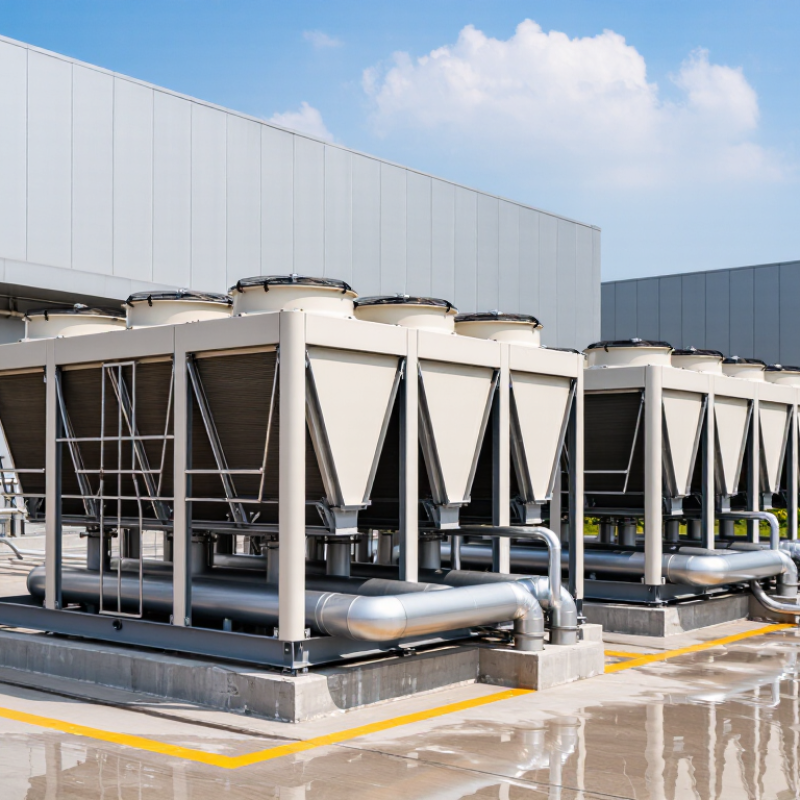
Air-cooled chillers remove heat from chilled water through refrigerant coils and outdoor fans. They suit buildings that need steady cooling but lack space or water for a cooling tower. Think of a hotel’s plant room, a hospital corridor, or a factory line requiring controlled process temperatures. The chiller sends cooled water to air handlers or process equipment, where it absorbs heat and returns for cooling. No cooling tower is needed. That can simplify installation, though outdoor units need clear airflow and can add noise near occupied spaces.
The International Energy Agency’s 2018 report, The Future of Cooling, estimated that installed air-conditioner units could grow from 1.6 billion in 2018 to 5.6 billion by 2050. This is a broad cooling forecast, not a chiller-specific prediction, but it signals rising demand for reliable cooling. Air-cooled systems are often practical for smaller and mid-sized sites, retrofits, and locations where water use is a concern. Their efficiency can fall during very hot weather, so buyers should check performance at local design temperatures, not just standard rating conditions. Fan sound matters, too. It is easy to overlook. Selection should also consider part-load operation, service access, and the actual cooling load; a larger unit is not automatically a better one.
China Best Air Cooling Chiller Suppliers for Global Buyers? – Understanding Air-Cooled Chillers and Their Main Applications
| Chiller Configuration | Indicative Cooling Capacity | Common Applications | Typical Design Conditions | Key Selection Considerations |
|---|---|---|---|---|
| Scroll air-cooled chiller | Approximately 5–300 kW per unit; capacity varies by model and operating conditions. | Small commercial buildings, clinics, laboratories, retail spaces, and light industrial processes. | A common comfort-cooling design point is 7°C leaving chilled water and 12°C return water. Actual conditions depend on the project. | Check part-load efficiency, sound level, minimum water flow, and whether the unit can operate at the site’s design outdoor temperature. |
| Modular scroll chiller | Often configured from several modules to serve loads from tens to several hundred kilowatts. | Hotels, offices, schools, mixed-use buildings, and sites where cooling demand changes throughout the day. | Modules are commonly connected to a shared chilled-water circuit; design temperatures and flow rates are project-specific. | Confirm staging logic, hydraulic arrangement, controls compatibility, redundancy requirements, and the footprint required for service access. |
| Screw air-cooled chiller | Commonly used for medium-to-large loads, often from roughly 100 kW to over 1,000 kW, depending on design. | Large commercial buildings, manufacturing facilities, data centers, and process-cooling systems. | May be designed for standard chilled water or lower-temperature process water; capacity and efficiency change with ambient and water temperatures. | Review full- and part-load performance, compressor configuration, operating envelope, electrical supply, and maintenance support availability. |
| Low-temperature air-cooled chiller | Capacity is application-dependent and is generally lower at colder leaving-fluid temperatures than at standard comfort-cooling conditions. | Plastics processing, food production, chemical processes, and equipment cooling that requires chilled glycol or sub-ambient fluid. | Fluid temperatures below the usual 7°C comfort-cooling point may require glycol, suitable controls, and a chiller designed for low-temperature operation. | Specify fluid type and concentration, required leaving-fluid temperature, process return temperature, and freeze-protection method. |
| Heat-recovery air-cooled chiller | Available in multiple capacity ranges; recoverable heat depends on cooling load, system design, and required hot-water temperature. | Facilities with simultaneous cooling and hot-water demand, such as hotels, hospitals, and selected industrial sites. | Heating-water temperatures and available heat recovery vary by unit design and operating conditions. | Compare the cooling and heating performance at actual project conditions; confirm controls, water temperatures, and the hours of simultaneous demand. |
| Air-cooled chiller with free-cooling option | Project-specific; free-cooling capacity depends on outdoor temperature, fluid temperature, and coil configuration. | Data centers and other facilities with year-round cooling loads in climates that have sufficiently cool outdoor conditions. | Free cooling is most useful when outdoor air is cool enough to reduce or displace compressor operation; it is climate- and load-dependent. | Request an annual energy assessment using local weather data; check changeover controls, coil maintenance, and freeze protection. |
| Note: Capacity ranges and design points are indicative, not product specifications or supplier rankings. Actual performance depends on the selected model, refrigerant, ambient conditions, fluid, flow rate, and applicable test standards. Buyers should compare certified performance data and confirm local electrical, safety, and regulatory requirements. | ||||